
Caring for International Students in the Classroom Context: Moving Beyond Intentions
Thi Thuy Trang Tran, University of Windsor
Introduction
Canada’s classrooms are more diverse than ever. With the 2024–2026 immigration plan aiming for 485,000 new permanent residents annually (Government of Canada, 2023), international and immigrant students are reshaping the Canadian higher education landscape. Ontario’s education policy promotes inclusion, cultural responsiveness, and student well-being (Ontario Ministry of Education, 2013). Yet, these ideals do not always align with the lived experiences of many international students.
I felt confused, demotivated, and isolated—not just by the content, but by the culture of learning itself.
As a newcomer, I struggled to adapt to discussion-heavy classrooms that assumed familiarity with Canadian academic norms. My experience reflects what Geneva Gay (2018) describes as the gap between caring about students and caring for them—a distinction with profound implications for teaching culturally and linguistically diverse students.
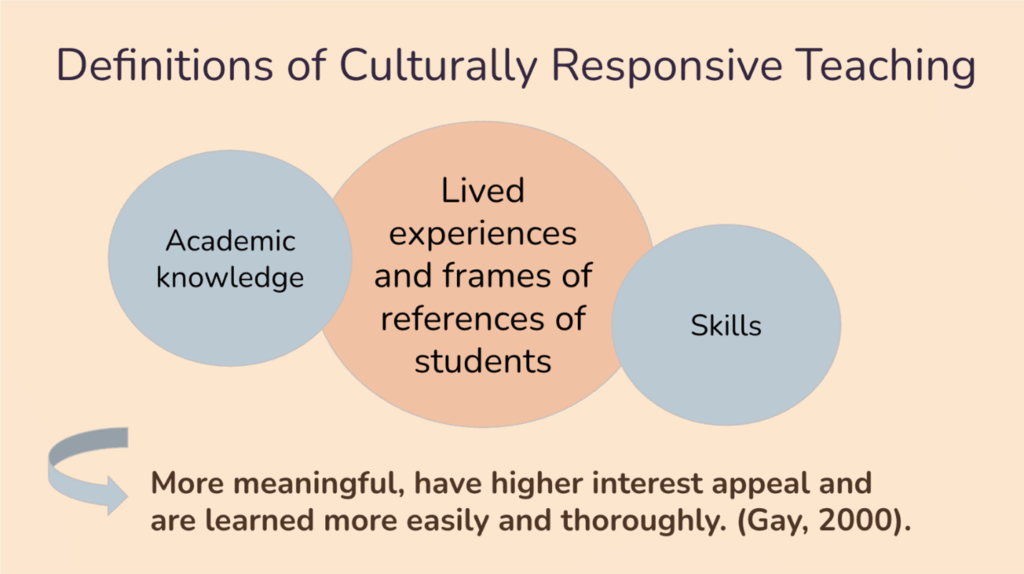
Culturally Responsive Teaching (CRT) is an evidence-based teaching pedagogy. Gay (2002) defines it as using students’ cultural backgrounds as assets in the learning process. More importantly, CRT calls for intentional, practical strategies that foster equitable learning environments. She defines Culturally Responsive Teaching (CRT) as “using the cultural characteristics, experiences, and perspectives of ethnically diverse students as conduits for teaching them more effectively” (p. 106). When academic knowledge and skills are integrated based on students’ lived experiences and prior knowledge, these learning connections become more meaningful, increasing student engagement and achievement. Table 1 shows the definitions of Culturally Responsive Teaching.
Table 1. Definitions of Culturally Responsive Teaching.
Moving from Empathy to Action: What “Caring For” Looks Like
In her later work, she distinguishes between caring about students—a passive emotional stance—and caring for them, which requires active effort, commitment, and responsive teaching (Gay, 2018).
Caring for students encompasses concern, compassion, commitment, responsibility, and action (Gay, 2018, p. 57).
This shift requires educators to move beyond symbolic inclusion toward intentional pedagogical decisions that reflect students’ cultural and linguistic realities.
The Reality of Feeling Excluded in “Inclusive” Classrooms
Despite instructors encouraging participation, many international students encounter subtle but powerful barriers that prevent meaningful engagement. Research from the Handbook of Research on Teaching Strategies for Culturally and Linguistically Diverse International Students (Smith & Zhou, 2022) highlights that while universities promote multicultural inclusivity, actual classroom experiences frequently fail to provide effective teaching practices for course-based and research-based graduate students.
Strategies for Caring for International Students
Multimodal Teaching Strategies
Integrate visual aids, videos, graphic organizers, and interactive tools alongside traditional texts. This connects directly to the difficulty international students face when professors assume they understand implicit academic expectations or subject-specific jargon without prior contextualization. For example, a university professor should acknowledge that some international students, particularly those from high-context, teacher-centred educational backgrounds, are reluctant to speak during classroom discussions.
To foster equitable engagement, the professor incorporates visual storytelling, infographics, and interactive concept maps instead of solely text-based lectures. Mind maps, infographics, or visual summaries can offer students alternative ways to demonstrate understanding, especially when language fluency is still developing. In one of my MEd classes, creating visual summaries allowed me to contribute meaningfully without the pressure of verbal fluency.
Building a Sense of Belonging
Apply Vygotsky’s sociocultural theory by creating learning environments where students’ identities are affirmed. Students who feel their cultural backgrounds are valued are more likely to engage and contribute actively. Some teaching examples could be adopting culturally relevant teaching materials such as:
- Incorporating global authors, case studies, and perspectives in course content to reflect diverse student backgrounds. Incorporate diverse cultural content (e.g., global case studies, multilingual resources) and invite students to share cultural insights during discussions
- Beginning each session with traditional music from a different country—a small gesture with a big impact on classroom climate.
- Acknowledging students’ cultural celebration or together creating a wall of culture.
Breaking Down Language Barriers
Many institutions assume that once students meet English proficiency requirements (e.g., IELTS, TOEFL), they can fully engage in coursework. However, research indicates that many international students continue to struggle with discipline-specific vocabulary, fast-paced lectures, and unfamiliar academic conventions (Huo & Khoo, 2022). Without proper linguistic scaffolding, students may experience anxiety, reduced participation, and lower academic performance. To enhance accessibility, educators can:
- Use subtitles, glossaries, and bilingual supports when possible.
- Implement lecture transcripts, visual aids, and multilingual glossaries to support comprehension.
- Repeat complex concepts with simplified language.
- Provide bilingual office hours or pair students with bilingual mentors can further bridge linguistic gaps, fostering confidence in academic discussions.
For example, an accounting professor who recognizes students struggling with legal terminology might create a course glossary with multilingual explanations, ensuring all students grasp key concepts before participating in discussions. This approach aligns with Culturally Responsive Teaching (Gay, 2018) by validating linguistic diversity and fostering an inclusive learning environment that promotes equitable academic success.
Active Support (“caring for” vs. “caring about”) – Move Beyond Empathy
For example, A Vietnamese student entering a Canadian classroom for the first time may experience a significant cultural shift, as traditional Vietnamese teaching methods emphasize respect for authority, silent observation, and passive learning. This aligns with what Kochman (1985) describes as a passive-receptive posture, where students are less likely to ask questions or actively contribute to discussions. In a Canadian classroom, teachers and peers might misinterpret this reserved behaviour as a lack of engagement or comprehension. A culturally responsive teacher, however, would recognize that the student’s hesitancy is culturally influenced rather than an indication of a lack of ability or motivation. To support their transition, the teacher might:
- Introduce alternative participation methods, such as small-group discussions, written reflections, or structured peer interactions, to provide the students with safer, lower-pressure opportunities to express their ideas. By blending purposeful actions with emotional support, the teacher fosters a classroom environment where students can thrive academically, culturally, and emotionally. This illustrates the essence of “caring for” in CRT, as it goes beyond general empathy to actively support and empower students from diverse cultural backgrounds.
- Allow flexible deadlines with context. Teachers can check in with students after a missed deadline to ask if external factors (housing, immigration stress, cultural holidays) are involved. It goes beyond rigid deadlines but recognizes the complex realities international students face beyond academics.
Conclusion
In conclusion, culturally responsive educators do not stop at caring about international students; they actively care for them by making systematic, thoughtful changes to their teaching practices. By fostering inclusivity, adapting instructional methods, and implementing structural support, educators can create learning environments where all students, regardless of cultural background, can thrive. Geneva Gay’s distinction between “caring about” and “caring for” challenges educators to move beyond acknowledgment and take action toward equitable, responsive, and transformative teaching.
References
Eaker-Rich, D., & Van Galen, J. (1996). Caring in an unjust world: Negotiating borders and barriers in schools. SUNY Press.
Gay, G. (2002). Preparing for culturally responsive teaching. Journal of Teacher Education, 53(2), 106–116. https://doi.org/10.1177/0022487102053002003
Gay, G. (2018). Culturally responsive teaching: Theory, research, and practice (3rd ed.). Teachers College Press.
Government of Canada. (2023). Canada’s 2024–2026 immigration levels plan. Immigration, Refugees and Citizenship Canada.
Khoo, E. & Huo, X. (2022). The efficacy of culturally responsive pedagogy for low-proficiency international students in online teaching and learning. Journal of Teaching and Learning, 16(2), 67–85. https://doi.org/10.22329/jtl.v16i2.7022
Kochman, T. (1985). Black and White styles in conflict. University of Chicago Press.
Ontario Ministry of Education. (2013). Culturally responsive pedagogy: Towards equity and inclusivity in Ontario schools. Queen’s Printer for Ontario.
Smith, C., & Zhou, G. (Eds.). (2022). Handbook of research on teaching strategies for culturally and linguistically diverse international students. IGI Global.
Vygotsky, L. S. (1978). Mind in society: The development of higher psychological processes. Harvard University Press.


About Post Author

